

Value optimization
Maximizing Strategic Decision-Making Across Global Projects
Title
UX Design Specialist
Time frame
Aug 2021 - June 2022
Summary
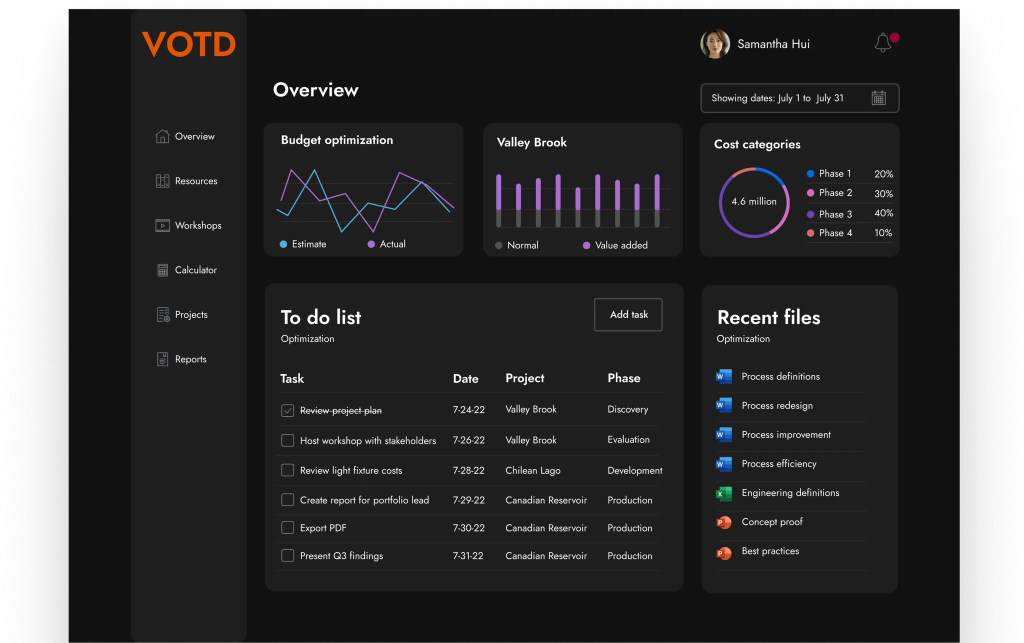
I led the UX design efforts for a web-based app focused on optimizing communication and decision-making across multi-million-dollar global projects. From user interviews and heuristic analysis, I addressed critical usability challenges. The result was an intuitive, stable platform that improved visibility, accountability, and strategic alignment for frontline contributors, portfolio leads, and executives.
Results
The redesigned VOTD platform delivered measurable improvements in usability, efficiency, and stakeholder satisfaction:
Enhanced User Satisfaction: Users reported a significantly improved experience, with faster workflows and reduced frustration.
Improved Decision-Making: Portfolio leads and executives gained clearer visibility into project performance, enabling data-driven strategic decisions.
Increased Efficiency: Streamlined filtering and navigation reduced the time required to access critical data.
Global Alignment: Consistent design patterns and clear workflows ensured usability across diverse user groups in Canada, Chile, and Australia.
Leadership Impact
Established a shared UX standards and research operating model across a 40+ person design organization, increasing consistency and reducing reliance on ad hoc usability testing.
Partnered with UX leadership, product, and procurement to secure enterprise access to Baymard Institute research, enabling evidence-based design decisions across 120+ projects.
Mentored and supported designers across multiple teams in applying research-backed patterns, improving confidence and decision quality.
Introduced repeatable critique and feedback practices that elevated design quality and accelerated alignment between UX, product, and engineering.
Acted as a connective layer between frontline designers and leadership, translating usability risks into business-relevant insights.
Supported strategic decision-making across 120+ capital projects ranging from $2M–$100M in value, representing hundreds of millions in total investment impact.
Challenge
The Value Optimization Tracking Dashboard (VOTD) was a critical tool for managing multi-million-dollar global projects, but it suffered from severe usability challenges that hindered its effectiveness:
Outdated and Complex Interface: The platform's legacy design was difficult to navigate, creating frustration for users.
Slow Performance: Long loading times disrupted workflows and reduced productivity.
Unintuitive Filtering: Users struggled to locate and analyze the data they needed, leading to inefficiencies.
Limited Visibility: Portfolio leads and executives lacked clear insights into project performance, impacting strategic decision-making.
Strategy
To address these challenges, I developed a structured UX strategy around improving the ease of use of this outdated, complex, dysfunctional web app.
User research
Conducted 1:1 interviews with users across Canada, Chile, and Australia to understand workflows and pain points.
Design Critique
Analyzed feedback to prioritize usability issues based on severity and frequency
Heuristic analysis
Identified recurring challenges, including slow loading times, unintuitive filtering, and inefficiencies.
UX Roadmap
Created a prioritized design roadmap aligned with key user pain points and business objectives
Collaboration with product team
Ensured user stories were tracked in JIRA for transparency and accountability.
Improving visibility for portfolio leads and executives relied heavily on empowering both frontline specialists with a stable, easy to use web app to have reliable global performance data
Process
My approach to redesigning VOTD was user-centered, iterative, and collaborative:
1. Discovery & Research
Conducted user interviews across three continents to understand diverse workflows
Performed heuristic analysis to identify usability violations
Gathered feedback from stakeholders to align on priorities
2. Design & Prototyping
Created wireframes and high-fidelity prototypes based on research insights
Simplified navigation and filtering mechanisms
Designed for clarity and consistency across all user touchpoints
3. Testing & Iteration
Conducted usability testing with representative users
Iterated on designs based on feedback and performance metrics
Validated solutions with stakeholders before implementation
4. Implementation & Handoff
Collaborated closely with developers to ensure design fidelity
Created detailed design specifications and user stories in JIRA
Monitored launch and gathered post-launch feedback for continuous improvement
Learnings
This project reinforced several key principles that guide my approach to UX design:
User research is non-negotiable
Direct engagement with users across different regions uncovered insights that assumptions alone could not provide. Their feedback shaped every design decision.
Stakeholder alignment drives success
Regular communication with portfolio leads, executives, and the product team ensured that the redesign addressed both user needs and business objectives.
Simplicity scales
Streamlining complex workflows into intuitive interactions made the platform accessible to users with varying levels of technical expertise.
Iteration creates excellence
Continuous testing and refinement ensured that the final design was not just functional but delightful to use.
Want to learn more about this project?
I'd be happy to discuss the details and insights from this case study.
Get in touch